

What is orthodontic treatment?
Orthodontic treatment uses fixed braces, clear aligners, or other appliances to move teeth and improve how the upper and lower teeth meet. A treatment plan may address crowding, spacing, tooth position, bite relationships, cleaning access, or a combination of functional and appearance concerns.
There is no single appliance that is best for every patient. The choice between metal braces, self-ligating braces, ceramic braces, Korean clear aligners, and Invisalign depends on the teeth, bite, treatment complexity, daily routine, cooperation, and budget.
When to arrange an orthodontic assessment
An assessment may be useful for:
- Crowded, rotated, or displaced teeth.
- Gaps between teeth.
- Protruding front teeth or concerns about lip position.
- A deep bite, open bite, or crossbite.
- An uneven bite or a lower jaw that shifts when closing.
- An unerupted, impacted, or ectopic tooth.
- Difficulty cleaning crowded areas.
- A missing tooth where space needs to be opened or closed before restoration.
- Tooth movement after previous orthodontic treatment.
- A retainer that is lost, damaged, or no longer fits.
- A child with limited space, a narrow arch, a developing bite concern, or a habit that may affect the teeth or jaws.
Problems that look similar in photographs may require different plans. Extraction decisions, appliance selection, and treatment duration should not be determined from external photographs alone.
What does an orthodontic assessment involve?
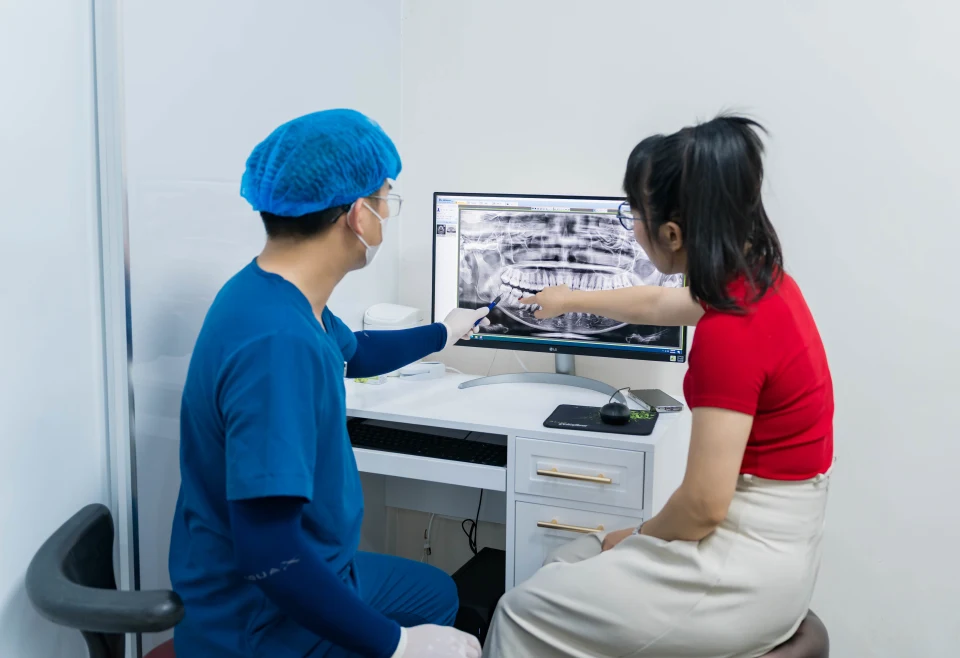
The dentist examines the teeth, gums, bite, jaw relationship, midlines, spacing, unerupted teeth, previous dental work, and cleaning access. Records may include facial and intraoral photographs, a scan or impressions, orthodontic imaging, and other measurements needed for planning.
Imaging may help assess roots, supporting bone, unerupted or impacted teeth, and relationships that cannot be evaluated from the mouth alone. Orthodontic imaging is separately priced at 300,000 ₫ per session, approximately $12.
Bring recent scans, X-rays, treatment plans, aligner records, and appliance information if available. Existing records may be useful, but new records may still be needed if the information is incomplete or the condition has changed.
Decay, active gum disease, heavy calculus, or a failing restoration may require treatment before or during orthodontics. Related services include dental fillings and teeth cleaning and scaling.
Orthodontic options at Hong Quynh Dental Clinic
Metal braces
Metal braces are fixed appliances using brackets and archwires to control tooth movement. They can be used for many types of movement and do not depend on remembering to wear an appliance each day. Careful cleaning, regular reviews, and avoiding foods that damage the appliance remain important.
Self-ligating metal braces
Self-ligating brackets use a built-in mechanism to hold the archwire instead of some conventional ties. They cost more than standard metal braces. Self-ligation does not guarantee less discomfort, fewer appointments, or faster treatment.
Ceramic braces
Ceramic brackets are closer to the color of natural teeth and may be less noticeable than metal brackets. They still require careful cleaning and handling. Suitability depends on the bite, tooth position, planned forces, and daily habits.
Korean clear aligners
Clear aligners can be removed for eating and cleaning. Progress depends heavily on wearing them for the prescribed time, changing trays as instructed, and attending reviews. The Korean clear-aligner category refers to the aligner option supplied by the clinic for the confirmed plan; it should not be treated as a particular brand unless the brand is documented.
Invisalign
Invisalign is a branded clear-aligner system. Aligners are discreet and removable, but they are not suitable for every case and do not have an automatic speed advantage over braces. The required movements, bite, complexity, and likely cooperation need to be assessed first.
Complete treatment package prices
The main prices below cover the confirmed complete two-arch active-treatment plan. They are not per-arch prices.
Simple orthodontic treatment
Complex orthodontic treatment
More complex orthodontic treatment
Ectopic or impacted-tooth treatment
The dentist confirms the complexity group after examining the teeth, bite, records, and treatment goals. Visible crowding alone does not establish the correct category.
Dollar estimates use the Vietcombank USD transfer-buying rate checked on 12 November 2026 at 14:45:33, Asia/Ho_Chi_Minh: $1 = 25,490 ₫. Vietnamese dong prices are authoritative. Dollar figures do not indicate that payment in US dollars is accepted.
You can also review the dental price list.
What does the main package include?
The main package covers the confirmed active orthodontic phase:
- Treatment planning based on the examination and required records.
- The primary braces or aligner system selected for the plan.
- Routine adjustments during active treatment.
- Monitoring tooth movement and the bite.
- Completion of the planned active-treatment phase.
The main package does not automatically include orthodontic imaging, treatment for decay or gum disease, extractions, auxiliary appliances, mini screws, rebonding a loose bracket, replacement of a lost or damaged aligner, retainers, or procedures outside the confirmed plan.
Before treatment, the written plan should identify the method, complexity category, goals, estimated schedule, package inclusions, separate items, and payment arrangement.
Separately priced appliances and services
Early-treatment and auxiliary appliances
Not every child or adult needs an auxiliary appliance. Selection depends on growth, arch form, bite, tooth eruption, and the specific treatment goal.
Mini screws and tooth intrusion
Mini screws may support anchorage or selected tooth movements. They are not needed for every case and do not guarantee a fixed reduction in treatment time.
Retention, imaging, and repairs
A lost, cracked, distorted, or poorly fitting aligner needs assessment before you move to another tray. Replacement cost depends on the treatment plan and actual situation and is not automatically included in the main package.
Payment options
Patients may choose full payment or payment by the confirmed stages of the treatment plan. Hong Quynh Dental Clinic accepts:
- Cash.
- Bank transfer.
Confirm the total package price, separate items, stage amounts, and payment dates before braces are fitted or aligners are delivered. USD values are comparison estimates only.
Do braces require tooth extraction?
Not every patient needs an extraction. The decision depends on crowding, tooth inclination, bite, supporting bone, lip position, facial relationships, impacted teeth, and treatment goals.
In selected cases, space may be managed through arch development, controlled interproximal reduction, tooth positioning, or another approach. These methods have limits and cannot replace extraction in every situation.
Wisdom teeth are not automatically removed simply because orthodontic treatment begins. Their position, effect on neighboring teeth, and relevance to the full plan need assessment. See the wisdom tooth removal guide when appropriate.
Can an impacted tooth be brought into position?
Some impacted or ectopic teeth can be exposed, given space, and moved with controlled orthodontic force. Feasibility depends on tooth position and direction, roots, bone, neighboring teeth, access, and the risk of root damage.
The plan may require additional imaging, surgical exposure, an anchorage appliance, or mini screws. These items are not automatically included unless documented in the treatment plan.
Orthodontic assessment for children
A child may benefit from assessment when there is visible crowding, limited space, a crossbite, a narrow arch, a developing overbite or underbite, delayed eruption, a suspected impacted tooth, or a habit affecting the teeth and jaws.
Early assessment does not mean braces must start immediately. The dentist may recommend monitoring growth, treating a specific developing problem, or waiting for a more suitable stage. Removable appliances, expanders, pre-orthodontic treatment, or fixed braces should have a defined goal rather than being applied routinely.
Orthodontics for adults
Adults may have orthodontic treatment when their teeth, gums, and supporting bone are sufficiently stable. Planning needs particular attention when there is:
- Active or previous gum disease.
- Gum recession or bone loss.
- Root canal treatment, crowns, bridges, or implants.
- Missing teeth or short roots.
- Tooth grinding or heavy bite forces.
- A medical condition or medicine affecting treatment.
Adult treatment may require coordination with restorative or gum care. Age alone does not determine the method or schedule.
How long does orthodontic treatment take?
Many active orthodontic plans take about 12-24 months, but treatment may be shorter or longer. This is a planning range, not a guaranteed completion date.
Timing depends on:
- The type and complexity of the bite problem.
- The number and distance of tooth movements.
- Impacted teeth or space creation.
- Extractions, mini screws, or auxiliary appliances.
- Gum and bone health.
- Individual biological response.
- Wearing aligners, elastics, or appliances as instructed.
- Attending reviews.
- Loose brackets, lost aligners, or treatment interruptions.
Reviews are commonly arranged about every 4-6 weeks, but the interval may change by method and treatment stage. Do not extend intervals or move to another aligner without instructions.
Discomfort and appliance problems
Teeth may feel tender or tight for several days after braces are fitted, an archwire is adjusted, elastics are introduced, or an aligner is changed. Lips and cheeks may also need time to adapt.
Contact the clinic if pain is severe or increasing, a wire is causing injury, a bracket is loose, an appliance is distorted, an aligner no longer fits, gum swelling or bleeding persists, a tooth feels unusually mobile, or there are signs of infection.
Do not glue a bracket, bend an appliance, cut a wire, or move to another tray unless the clinic has advised you what to do.
Cleaning and eating during treatment
Plaque around brackets and crowded areas increases the risk of gum inflammation, decay, and white enamel marks. During treatment:
- Clean carefully around brackets, wires, and the gumline.
- Use interdental brushes, floss, or another recommended aid.
- Clean aligners before replacing them.
- Limit frequent sugary or acidic snacks and drinks.
- Avoid biting hard, sticky, or chewy food with fixed braces.
- Continue routine dental and gum care.
- Contact the clinic promptly about a loose bracket, irritating wire, or damaged aligner.
Clear aligners should be removed for eating as instructed and worn for the prescribed daily time. Irregular wear can make the next tray fit poorly and delay progress.
Retainers and relapse
After active tooth movement, the tissues and bone need time to adapt. Teeth can change position again, so retention is a necessary part of treatment.
The dentist may recommend a removable retainer, fixed lingual wire, or both. The type, wear schedule, and review interval depend on tooth position, relapse risk, and cleaning access. Retainers and fixed wires are separately priced.
Contact the clinic if a retainer is lost, cracked, painful, or no longer fits, if a fixed wire becomes loose, or if teeth appear to be moving. Do not force a retainer that no longer seats correctly.
Orthodontic results are not guaranteed to remain unchanged permanently. Following the retention plan and seeking review when something changes help reduce relapse risk.
Short stays and existing orthodontic treatment
A short-stay visitor may request an English assessment, second opinion, review of records, or evaluation of an irritating wire, loose bracket, or damaged aligner. Full orthodontic treatment normally requires regular local follow-up over many months and is not presented as a short-stay procedure.
If you started treatment elsewhere, Hong Quynh Dental Clinic can assess the current appliances, records, original goals, progress, and remaining work. Assessment does not guarantee that the existing system can be continued, that the original plan will be retained, or that a particular transfer fee will apply.
Bring or send:
- The original treatment plan and records.
- Recent X-rays, photographs, and scans.
- Bracket or aligner system information.
- Remaining aligners if applicable.
- Details of extractions, mini screws, or other procedures.
- Your expected time in Hanoi and future travel plans.
Contact Hong Quynh Dental Clinic
Hong Quynh Dental Clinic provides orthodontic assessment at 14 Lane 36 Mieu Dam Street, Tu Liem, Hanoi.
For the quickest response, message Hong Quynh Dental Clinic on WhatsApp with your age, main concern, current appliance, recent records, available dates, and expected time in Hanoi. You can also:
- Use Zalo.
- Call +84 965 794 622.
- Send details through the contact page.
- Request an orthodontic appointment.
After assessment, the dentist will confirm the method, complexity category, package inclusions, separate items, estimated schedule, follow-up needs, and payment arrangement.