

What is a dental implant?
A dental implant replaces the root support for a missing tooth. The complete restoration usually has three main parts:
- The implant fixture is placed in the jawbone.
- The Abutment connects the implant fixture to the visible restoration.
- The final crown provides the tooth shape and chewing surface above the gum.
Implants may support one crown, a bridge replacing several teeth, or a full-arch restoration. Treatment is planned around the final tooth position rather than simply placing a fixture wherever bone is available.
An implant is not automatically the best solution for every missing or damaged tooth. If a natural tooth can reasonably be treated and maintained, preserving it should be considered before extraction and implant replacement.
When to arrange an implant assessment
An assessment may be useful if you:
- Have one missing tooth and want to avoid using the neighboring teeth to support a conventional bridge.
- Have several missing teeth and want to discuss an implant-supported bridge.
- Have a loose or uncomfortable removable denture.
- Are missing all teeth in one arch and want to explore fixed full-arch treatment.
- Have a severely damaged tooth that is being assessed for preservation or extraction.
- Lost a tooth some time ago and are concerned about bone loss.
- Already have an implant but have a problem with the crown, Abutment, gum, or another component.
- Need an English explanation of a previous implant recommendation or scan.
An early assessment helps clarify the condition of the space, neighboring teeth, opposing bite, gum, and available bone. It does not commit you to treatment.
Who may be suitable for dental implants?
Suitability depends on more than age or how long the tooth has been missing. The dentist considers:
- The number and position of missing teeth.
- Bone height, width, and quality at the proposed site.
- Gum health and any history of periodontal disease.
- Decay, infection, or disease affecting the remaining teeth.
- Bite forces and tooth-grinding habits.
- The position of nerves, the maxillary sinus, and neighboring roots.
- General health, allergies, previous surgery, and current medicines.
- Blood glucose control for a patient with diabetes.
- Smoking or nicotine use.
- Oral hygiene and the ability to attend long-term maintenance.
- Jaw growth in a younger patient.
Diabetes, a history of gum disease, or smoking does not automatically rule out implants, but these factors may affect healing and long-term risk. Tell the clinic about blood thinners, medicines that affect bone metabolism, cancer treatment, immune conditions, and other relevant care. Coordination with your medical clinician may be required before surgery.
Active gum disease, uncontrolled decay, infection, or poor plaque control may need treatment before or alongside implant planning.
Implant assessment, CBCT, and previous records
Planning begins with a clinical examination. The dentist evaluates the missing-tooth space, teeth, gums, bite, mouth opening, and existing restorations. A CBCT scan provides three-dimensional information about bone, neighboring roots, nerves, the sinus, and other structures that may influence treatment.
CBCT does not replace a clinical examination. The implant position and final restoration need to be planned together so that the completed tooth has a practical shape, bite, emergence profile, and cleaning access.
Bring or send any recent dental imaging, treatment plans, implant passport, component information, and relevant medical records. Existing records may be useful, but new imaging may still be required if the information is incomplete or the condition has changed.
Complete single-tooth implant package prices
Hong Quynh Dental Clinic offers the following complete standard packages for one tooth:
Dollar estimates use the Vietcombank USD transfer-buying rate checked on 12 November 2026 at 14:45:33, Asia/Ho_Chi_Minh: $1 = 25,490 ₫. Vietnamese dong prices are authoritative. The estimates do not mean that payment in US dollars is accepted.
There is no single best implant system for every patient. Selection depends on the treatment site, bone, fixture dimensions, restorative components, bite forces, schedule, maintenance needs, and budget. Country of origin, price, or warranty length alone does not establish clinical suitability.
You can also review the clinic's dental price list.
What the standard package includes
The standard complete single-tooth package includes:
- Initial implant consultation.
- Clinical assessment and restorative planning.
- Planning CBCT for the package.
- The selected implant fixture.
- Fixture placement and local anesthesia.
- A standard healing component.
- A standard Abutment.
- A standard final crown.
- Routine scanning or impressions required for the package.
- Routine reviews during completion of the package.
The crown material, Abutment type, restoration design, and specific components are confirmed in the treatment plan. The standard package does not automatically include bone grafting, sinus lifting, upgraded components, treatment of another tooth, gum treatment, or procedures outside the agreed single-tooth plan.
The initial implant consultation is free. This does not mean that every scan, preliminary procedure, or treatment outside a confirmed package is free.
When separately listed component prices apply
The following prices apply to standalone, replacement, upgraded, or additional work outside the confirmed standard package:
A standard component already included in a complete package is not added again as a separate item. The clinic will identify included and separately priced work before treatment.
Bone grafting and sinus lifting
If there is not enough bone for the planned implant position and size, the dentist may consider grafting, sinus lifting, or a different restorative approach.
Long-term tooth loss does not automatically mean grafting or sinus lifting will be required. The need depends on the CBCT findings, implant position, remaining bone, sinus anatomy, and final restoration. Any material or procedure beyond the listed items is confirmed in the quotation before treatment.
Payment
Patients may choose full payment or payment by the confirmed stages of the treatment plan. Hong Quynh Dental Clinic accepts:
- Cash.
- Bank transfer.
Confirm package inclusions, separately priced work, the total quotation, and the payment schedule before treatment begins. Dollar values are for comparison only and do not indicate that USD payment is available.
Comparing implant systems
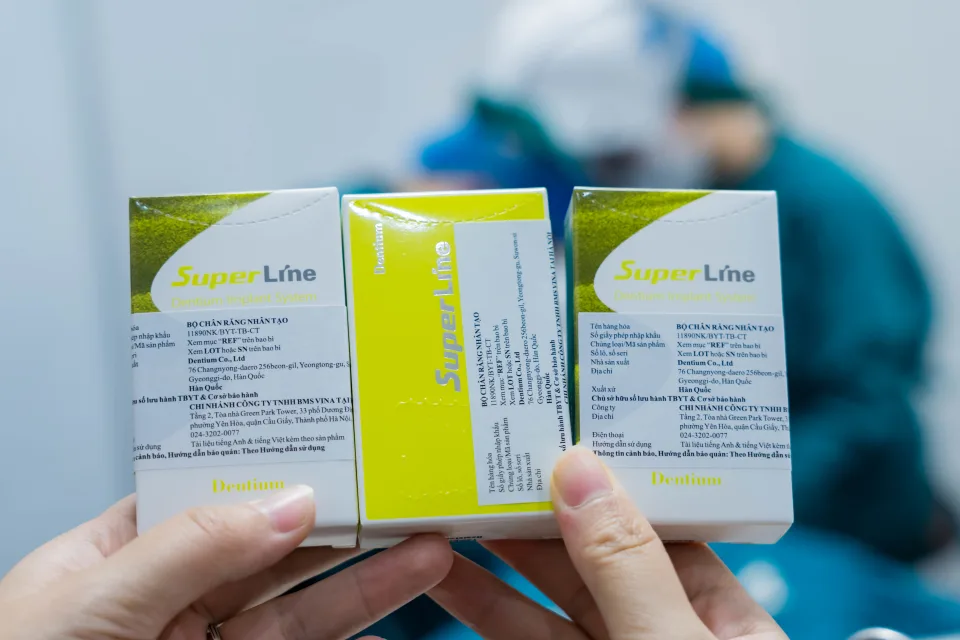
Biotem, Dentium, Hiossen, Straumann, and Straumann Active differ in their fixture systems, designs, surfaces, restorative components, supply chains, and listed fixture warranties. These differences need to be considered within the whole treatment plan.
The dentist can discuss:
- The system and fixture size considered for the site.
- Component availability for the proposed restoration.
- Bone and loading considerations.
- The planned treatment stages.
- Future maintenance, repair, and component replacement.
- Budget and the listed fixture warranty.
The warranty periods on the price list apply to the implant fixture. They do not automatically apply for the same duration to the crown, Abutment, restorative screw, or other components. A warranty is also not a promise that an implant or restoration will last for life.
Stages of single-tooth implant treatment
1. Examination and planning
The dentist reviews your dental condition, medical history, CBCT, bite, and restorative goal. Infection, gum disease, decay, or a medical concern may need attention before the surgical stage.
2. Preparing the site
A tooth that cannot be retained may need extraction. Depending on the site, an implant may be placed during the extraction appointment or after a period of healing. Bone grafting or sinus lifting is added only when indicated.
3. Placing the implant fixture
Local anesthesia is used. The dentist prepares the planned position, places the fixture, and assesses its initial stability. A healing component or cover screw is selected according to the soft tissue and one-stage or two-stage plan.
4. Healing and review
The implant needs time to become stable in the bone before the final restoration carries full function. The dentist reviews the gum, hygiene, symptoms, and fixture stability before moving to the restorative stage. The absence of pain does not by itself confirm that healing is complete.
5. Scan or impression and restoration
When the site is ready, the clinic records the implant position, bite, and required tooth shape. The Abutment and final crown are selected or designed for the plan.
6. Fitting and maintenance instructions
The dentist checks fit, neighboring contacts, bite, shape, cleaning access, and restoration stability. You receive instructions for home care and future reviews.
How long does implant treatment take?
A straightforward staged single-tooth plan commonly takes about 3-6 months from fixture placement to the final restoration. This is an estimate, not a guaranteed completion date.
Treatment may take longer when:
- Infection, decay, or active gum disease needs preliminary care.
- The extraction site needs to heal first.
- Bone grafting or sinus lifting is required.
- Initial fixture stability or healing needs more time.
- Several implants or a full-arch restoration are planned.
- General health or healing needs closer review.
- Appointments are interrupted by work, travel, or relocation.
The gum may feel comfortable before the implant is ready for full loading. Treatment should not be accelerated only because symptoms have settled.
Immediate placement and a temporary tooth
Immediate placement means the implant fixture is placed during the same appointment as the extraction. It may be considered when the site, available bone, infection status, gum, bite, and expected initial stability are suitable.
Immediate placement does not automatically mean an immediate final tooth. A same-day temporary tooth or fixed provisional may be considered when stability and bite conditions allow. It is not the final crown and usually needs protection from excessive force.
A temporary tooth is not a standard inclusion for every single-tooth package. Its design, timing, and any additional cost are confirmed in the individual plan.
Replacing several teeth
Several missing teeth do not always require one implant for every tooth. In selected cases, an implant-supported bridge can replace a group of teeth using fewer fixtures than the number of missing teeth.
The number and position of fixtures depend on bone, the length of the space, bite forces, restoration design, and cleaning access. The plan is confirmed after examination and CBCT review.
Full-arch treatment with All-on-4 or six implants
Hong Quynh Dental Clinic provides assessment for All-on-4 and six-implant full-arch treatment. All-on-4 uses four fixtures to support a full-arch restoration, while the six-implant option uses six. Fixture count alone does not decide which approach is more suitable.
A same-day fixed provisional may be considered in selected full-arch cases when initial stability and the clinical conditions allow. It should not be understood as a guaranteed same-day final restoration.
There is no single public package price for All-on-4 or a six-implant full arch. The quotation depends on the CBCT findings, implant system, number and position of fixtures, grafting needs, provisional stage, and final restoration design.
Planning treatment during a short stay in Hanoi
An English consultation, examination, CBCT, or treatment-plan discussion may fit within a short stay. Complete implant treatment usually requires coordinated visits over several months, so fixture placement during a brief visit should only be considered when the surgical and restorative follow-up can be arranged safely.
Before booking treatment, share:
- Your arrival and departure dates.
- Any future visits to Hanoi.
- Recent scans and dental records.
- Relevant medical conditions and medicines.
- Whether another dentist may provide follow-up at your destination.
- Your expectations for a temporary tooth.
If you leave Hanoi during healing, ask for the implant system, fixture information, surgical summary, imaging, component details, and the planned date for the next stage. Do not assume another clinic can continue treatment without reviewing the records and compatible components.
There is no universal waiting period before work, long-distance travel, or flying. Discuss the procedure, grafting, symptoms, destination, and access to follow-up with the dentist before fixing travel plans.
Does implant placement hurt?
Fixture placement is performed with local anesthesia. You may notice pressure, vibration, or movement, but tell the dentist immediately if you feel sharp pain.
Pain, swelling, mild bruising, tightness, or chewing difficulty may occur afterward. The amount varies with the number of implants, procedure extent, grafting or sinus work, tissue condition, and individual response.
Not every patient needs the same medicines. Follow the prescription and instructions provided for your case. Do not reuse old antibiotics, change a dose, or stop a prescribed medicine without appropriate guidance.
Aftercare and warning symptoms
Instructions vary with the site and procedure, but common principles include:
- Follow the guidance for gauze and minor bleeding.
- Avoid forceful rinsing, spitting, or disturbing the wound during the early period.
- Choose soft, cool or warm food and avoid chewing directly on the treated area when instructed.
- Keep the rest of the mouth clean and clean the surgical area as directed.
- Do not pull the lip repeatedly or touch the site with fingers or objects.
- Limit alcohol and avoid smoking during healing.
- Take medicines exactly as directed.
- Attend the planned wound and healing reviews.
Contact the clinic for uncontrolled bleeding, increasing pain or swelling, fever, pus, persistent bad taste or odor, wound opening, prolonged altered sensation, a loose temporary restoration, a mobile component, or a medicine reaction.
Breathing difficulty, significant swallowing difficulty, rapidly spreading swelling, uncontrolled bleeding, or a severe allergic reaction requires urgent local medical care. If you have left Hanoi, seek appropriate care where you are and update Hong Quynh Dental Clinic when possible.
Long-term implant maintenance
An implant cannot develop enamel decay, but the gum and supporting bone can become inflamed. Plaque, ineffective cleaning, smoking, a history of gum disease, poorly controlled diabetes, unfavorable bite forces, and restoration design can affect long-term risk.
Long-term care includes:
- Cleaning around the implant every day.
- Using floss, interdental brushes, or other aids appropriate for the restoration.
- Attending professional cleaning and implant reviews at an individualized interval.
- Checking the bite, crown, bridge, screw, and Abutment when symptoms develop.
- Managing smoking, grinding, gum disease, and relevant general health conditions.
- Seeking help for red, tender or bleeding gum, swelling, pus, persistent odor, pain, or restoration movement.
The crown, screw, Abutment, or other restorative component may wear, loosen, chip, or require replacement even when the implant fixture remains stable. Fixture warranty length and the expected lifespan of the complete restoration are not the same.
Alternatives to dental implants
The appropriate replacement depends on the teeth, bone, gums, bite, health, schedule, budget, and maintenance preferences.
- An implant can support a crown, bridge, or full-arch restoration without necessarily using neighboring teeth as bridge supports.
- A conventional bridge may be suitable but usually requires assessment and preparation of supporting teeth. Learn more about dental crowns and bridges.
- A removable denture may replace several teeth with less surgery, but stability, sensation, and cleaning differ from a fixed restoration.
- Monitoring a space may be reasonable in selected situations, but movement of neighboring or opposing teeth and changes in function should be considered.
If a natural tooth can reasonably be retained, treatment to preserve it should be discussed before extraction for an implant.
Contact Hong Quynh Dental Clinic
Hong Quynh Dental Clinic provides free initial implant consultations at 14 Lane 36 Mieu Dam Street, Tu Liem, Hanoi.
For the quickest response, send a message on WhatsApp with the missing tooth or teeth, symptoms, recent imaging, medical conditions, available dates, and departure date if relevant. You can also:
- Use Zalo.
- Call +84 965 794 622.
- Send details through the contact page.
- Request an implant appointment.
The dentist will confirm suitability, package inclusions, separately priced work, treatment stages, follow-up requirements, and payment arrangements after assessment.