

Planning wisdom tooth care in Hanoi
Wisdom teeth, also called third molars, are the last teeth at the back of the mouth. They may erupt normally, emerge only partly, grow at an angle, or remain impacted beneath gum or bone.
Hong Quynh Dental Clinic assesses wisdom-tooth pain, swelling, recurrent inflammation, food trapping, decay, and impacted teeth, with treatment explanations available in English.
If you are visiting Hanoi for a limited time, share your symptoms, available dates, departure date, flight schedule, recent dental imaging, medical conditions, and current medicines when contacting the clinic. Examination and removal may sometimes be arranged during the same visit, but this is not guaranteed.
The page does not publish a fixed removal time. Appointment length depends on tooth position, root anatomy, access, nearby structures, imaging findings, inflammation, surgical steps, and the number of teeth being treated.
Does every wisdom tooth need removal?
No. A wisdom tooth that is healthy, fully erupted, easy to clean, and not harming the neighboring tooth may be monitored rather than removed.
The absence of pain does not prove that a wisdom tooth is healthy. It may still have decay, gum problems, food trapping, damage to the adjacent second molar, or changes visible only on imaging.
The dentist considers:
- Whether the tooth has erupted fully.
- Its direction and available space.
- Whether the area can be cleaned effectively.
- Decay or gum inflammation around the tooth.
- Effects on the neighboring second molar.
- Root position and surrounding bone.
- Possible cystic or other associated changes.
- Its relationship to a lower-jaw nerve or the maxillary sinus.
- Whether reliable monitoring is possible.
- Orthodontic or restorative plans.
If removal is not currently recommended, the tooth can be monitored and reassessed if symptoms or imaging findings change.
When to arrange an examination
Arrange an assessment if you have:
- Pain or tenderness at the back of the jaw.
- Swollen, red, or bleeding gum around a wisdom tooth.
- Recurrent inflammation under a gum flap.
- Food repeatedly trapping between the wisdom tooth and second molar.
- Persistent bad breath or an unusual taste from the area.
- Decay in the wisdom tooth or adjacent second molar.
- A partly erupted, angled, or impacted tooth.
- Pain spreading toward the ear, temple, or jaw angle.
- Difficulty opening your mouth.
- Pain or difficulty when swallowing.
- A cyst or bone change identified on imaging.
- A need to assess wisdom teeth before orthodontic or other dental treatment.
Pain at the back of the jaw is not always caused by a wisdom tooth. The dentist may need to distinguish it from second-molar decay, gum disease, jaw-joint problems, or another condition.
Wisdom tooth removal prices
Prices by jaw
Detailed position and complexity categories
The detailed rows describe position and complexity categories for lower wisdom teeth. They are not added to the general lower-jaw price.
The exact category and cost are confirmed after the dentist assesses angulation, depth, root anatomy, access, the neighboring tooth, and diagnostic imaging when needed.
Vietnamese dong prices are authoritative. Dollar estimates use the Vietcombank USD transfer-buying rate checked on 12 November 2026: $1 = 25,510 ₫, rounded to the nearest whole dollar.
Dollar figures are provided for comparison and do not indicate that payment in US dollars is accepted. You can also review the clinic's English dental price guide.
Optional supportive services
PRF and the supportive injection are not automatically required for every removal. The dentist discusses their indication, limitations, and cost when relevant. Neither service guarantees the absence of pain or swelling or a fixed recovery time.
Payment
Hong Quynh Dental Clinic accepts:
- Cash.
- Bank transfer.
Confirm the removal category, separately priced items, and total cost before treatment.
What the removal price includes
The confirmed removal price includes the clinical steps required by the agreed plan:
- Clinical examination before removal.
- Assessment of the surrounding gum and adjacent tooth.
- Local anesthesia.
- Extraction or minor surgery according to the plan.
- Sectioning of the crown or roots when required.
- Limited bone removal when required.
- Cleaning and irrigation of the socket.
- Suturing when required.
- Gauze and postoperative instructions.
- Scheduled postoperative review.
- Suture removal when non-dissolving sutures are used.
- Urgent assessment for unexpected postoperative symptoms.
Additional treatment for a complication may have a separate cost depending on its cause, severity, and required management. The clinic explains that cost before additional treatment.
Which items may be charged separately?
Depending on the findings, separately discussed items may include:
- A panoramic X-ray.
- A localized dental X-ray.
- CBCT imaging.
- PRF.
- A supportive injection for pain and swelling.
- Management of acute inflammation before removal.
- Treatment of an affected second molar.
- Periodontal treatment.
- Additional treatment for a complication.
- Medical consultation or laboratory testing when required.
- Prescribed medicine purchased from a pharmacy.
Not every patient needs these items. The reason, proposed option, and cost are explained before they are provided.
X-rays and CBCT
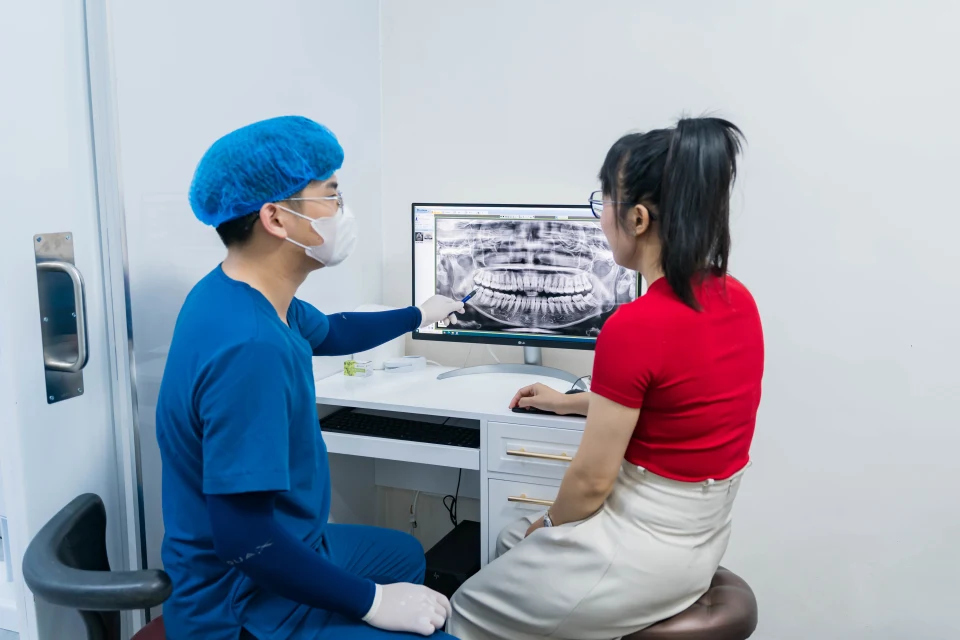
Diagnostic imaging helps the dentist assess tooth position, direction, root anatomy, the adjacent second molar, surrounding bone, and relationships to structures such as the lower-jaw nerve or maxillary sinus.
Depending on the case, the dentist may consider:
- A localized dental X-ray for a limited area.
- A panoramic X-ray for a broader view of the jaws.
- CBCT when three-dimensional information about roots or nearby structures is needed.
CBCT is not automatically required for every wisdom tooth. Imaging is selected according to the examination, available recent images, and the information needed for planning.
If you already have recent imaging, send or bring it to the appointment. The dentist will assess whether it is suitable or whether updated imaging is necessary.
Local anesthesia and treatment sensations
Hong Quynh Dental Clinic performs wisdom tooth removal with local anesthesia. Local anesthesia is included in the removal price.
The clinic does not provide conscious sedation, intravenous sedation, or general anesthesia for this service.
Once the area is numb, the aim is to control sharp pain. You may still notice:
- Pushing or pulling pressure.
- Instrument vibration.
- Pressure around the tooth.
- Sounds as the tooth is sectioned or removed.
Tell the dentist immediately if you feel sharp pain or believe the area is not sufficiently numb.
Examination and removal process
1. Discuss symptoms, health, and travel plans
Explain your pain, swelling, recurrent inflammation, allergies, medical conditions, current medicines, supplements, pregnancy status, available dates, departure date, and flight plans.
2. Examine the tooth and surrounding tissues
The dentist checks the wisdom tooth, gum, mouth opening, adjacent second molar, inflammation, and any issue requiring attention before removal.
3. Review imaging when needed
Existing images are reviewed, or appropriate imaging is recommended if more information about roots or nearby structures is required.
4. Discuss options, risks, and cost
The dentist explains monitoring or removal, the expected approach, local anesthesia, relevant risks, included items, and possible separate costs.
5. Administer local anesthesia
The area is numbed and sensation is checked before the procedure begins.
6. Access and remove the tooth
Depending on its position, the dentist may need to open the gum, section the tooth, or remove a limited amount of bone to complete the planned removal.
7. Clean the site and place sutures when needed
The socket is checked, cleaned, and irrigated. Sutures are placed when required.
8. Control bleeding and explain aftercare
Gauze is placed, bleeding is reviewed, and you receive instructions about food, oral hygiene, medicine when prescribed, warning symptoms, and follow-up.
How long does removal take?
This page does not publish a fixed procedure time because complexity varies significantly between teeth.
Appointment length depends on:
- Upper or lower jaw position.
- Straight, angled, or impacted position.
- Depth beneath gum or bone.
- Root number, shape, and direction.
- Proximity to a nerve, sinus, or adjacent tooth.
- Mouth opening and access.
- Active inflammation or infection.
- The need for tooth sectioning, bone removal, or suturing.
- The number of teeth treated during the visit.
The dentist discusses expected timing after examination and imaging when needed. The appointment also includes preparation, local anesthesia, bleeding control, and aftercare instructions.
Same-day examination and removal
Examination and removal may be completed during the same visit when the dentist has enough information, considers the procedure appropriate, and confirms that your health allows treatment.
A later appointment may be needed when:
- More imaging or medical information is required.
- Acute inflammation or infection needs initial management.
- Testing or advice from your medical clinician is needed.
- You cannot allow enough time for treatment and immediate aftercare.
- A complex case requires different preparation.
- A medicine or health concern needs review.
Having a same-day examination does not guarantee same-day removal.
Removing two or four wisdom teeth in one visit
Some patients may be considered for removal of more than one wisdom tooth during the same appointment.
The decision considers:
- The position and complexity of each tooth.
- The total extent of treatment.
- General health and bleeding history.
- Eating and oral-hygiene needs during recovery.
- Support available after treatment.
- Work, study, travel, and flight plans.
- Your preference after the options are explained.
Treating several teeth can reduce the number of appointments but increases the area requiring care during the same recovery period. The dentist does not apply one approach to every patient.
Painful or inflamed wisdom teeth
Pain or inflammation does not automatically mean removal must be delayed, but it also does not guarantee immediate treatment.
The dentist assesses:
- Pain and swelling.
- Gum-flap inflammation or pus.
- Mouth opening.
- Fever or signs of spreading infection.
- Pain or difficulty swallowing.
- The condition of the adjacent second molar.
- Medical conditions and current medicines.
Depending on the findings, the dentist may remove the tooth that day, schedule another visit, or manage the acute condition first.
Rapidly spreading swelling, difficulty breathing or swallowing, high fever, or marked restriction in mouth opening requires prompt assessment.
Medical information to provide
Before removal, tell the clinic about:
- Medicine or material allergies.
- Anticoagulants, antiplatelet medicine, and other current prescriptions.
- Non-prescription medicine and supplements.
- Previous prolonged bleeding.
- Heart disease, high blood pressure, diabetes, or liver or kidney disease.
- Osteoporosis treatment or medicine affecting bone metabolism.
- Immune-system conditions.
- Pregnancy or breastfeeding.
- Previous problems with dental anesthesia or extraction.
- Relevant imaging and treatment records.
Do not stop or change a prescribed medicine yourself. The dentist will explain if coordination with your medical clinician is needed.
Prescriptions and antibiotics
Hong Quynh Dental Clinic does not sell medicine. When medicine is indicated, the dentist provides a prescription and instructions so that you can purchase it from a pharmacy.
Not every wisdom tooth removal requires antibiotics. Prescribing depends on infection, inflammation, procedure extent, general health, allergies, and clinical findings.
You should:
- Report all medicine allergies.
- Provide your current medicine and supplement list.
- Follow the prescription and instructions.
- Avoid changing the dose or extending treatment yourself.
- Avoid using an old prescription or self-starting antibiotics.
- Contact the clinic if you develop a rash, breathing difficulty, or another unexpected reaction.
Medicine purchased from a pharmacy is not included in the removal price.
Recovery and returning to work, study, or travel
After local anesthesia wears off, you may experience:
- Pain or tightness around the site.
- Swelling during the early recovery period.
- Mild facial bruising.
- Jaw stiffness or reduced mouth opening.
- Difficulty chewing on the treated side.
- A small amount of blood in the saliva initially.
Recovery varies with tooth position, surgical complexity, number of teeth removed, active inflammation, general health, and aftercare.
There is no universal date for returning to work or study. Light desk work may be manageable sooner than physical work, frequent speaking, long-distance travel, or strenuous activity.
There is also no universal waiting period before flying. Discuss your flight schedule before treatment. The dentist considers procedure complexity, swelling, bleeding, follow-up needs, and your destination before advising on travel planning.
Care during the first day
Follow the instructions provided for your procedure. Common principles include:
- Keep the gauze in the correct position for the instructed time.
- Do not rinse forcefully, spit repeatedly, or touch the socket during the first day.
- Do not use a straw.
- Avoid very hot, hard, crunchy, or small food that may enter the socket.
- Eat soft food when numbness has reduced enough to avoid biting your lip or cheek.
- Do not smoke or use tobacco.
- Avoid alcohol.
- Avoid strenuous activity for the advised period.
- Do not remove the blood clot or material from the socket.
- Take prescribed medicine according to instructions.
If bleeding restarts, place clean gauze over the site and apply steady biting pressure as instructed. Contact the clinic if bright-red bleeding remains heavy or cannot be controlled.
Oral hygiene after the first day
Keep your mouth clean while avoiding injury to the socket.
- Brush the other teeth normally and be gentle near the treated area.
- Do not place a toothbrush, toothpick, or another object into the socket.
- Begin gentle rinsing only according to the instructions provided.
- Remove food around the area using the advised method.
- Continue softer food until chewing becomes comfortable.
- Do not remove sutures yourself.
Instructions may differ according to tooth position, sutures, and healing progress.
Risks and limitations
Wisdom tooth removal is common, but complications can occur. The dentist explains risks relevant to your tooth before treatment.
Possible issues include:
- Pain, swelling, bruising, or jaw stiffness.
- Persistent bleeding.
- Infection.
- Dry socket.
- Delayed healing.
- Damage to the adjacent tooth or restoration.
- Retention of a root fragment when complete removal would create greater risk.
- Numbness, tingling, or altered feeling in the lip, chin, or tongue when a lower tooth is close to a nerve.
- Sinus-related concerns with some upper wisdom teeth.
- A need for additional treatment or monitoring if a complication occurs.
Imaging helps evaluate risk but cannot eliminate every complication.
Dry socket
A blood clot normally protects the healing socket. If the clot does not form properly or is lost too early, pain may increase rather than improve.
Contact the clinic if you develop:
- Markedly increasing pain after the first few days.
- Pain spreading toward the ear or temple.
- Bad breath or an unpleasant taste from the socket.
- A socket that appears empty or extremely sensitive.
- Pain that is not controlled by the advised medicine.
Smoking increases the risk of poor healing and dry socket. Do not place medicine, chemicals, or home remedies into the socket yourself.
When to seek prompt help
Contact Hong Quynh Dental Clinic promptly if:
- Bleeding is heavy or cannot be controlled.
- Pain or swelling becomes stronger instead of improving.
- You develop fever, pus, persistent odor, or an unusual taste.
- Mouth opening becomes more restricted.
- Numbness or altered sensation persists or becomes more noticeable.
- Swallowing becomes painful or swelling spreads.
- Medicine causes an unexpected reaction.
- Sutures loosen or the wound appears abnormal.
Difficulty breathing, significant difficulty swallowing, rapidly spreading swelling, uncontrolled bleeding, or a severe allergic reaction requires urgent care at the nearest appropriate medical facility.
Follow-up and suture removal
Scheduled postoperative review, suture removal, and urgent assessment for unexpected symptoms are included in the removal price.
The dentist may review:
- Pain and swelling.
- Healing progress.
- The socket and surrounding gum.
- Sutures when present.
- Cleaning around the site.
- Whether further care is needed.
Treatment of a complication requiring an additional procedure may have a separate cost. The proposed treatment and cost are explained first.
If you will leave Hanoi before a planned review, tell the dentist before treatment. Ask about the suture type, when an assessment may be needed, and how to arrange continued care at your destination.
Contact Hong Quynh Dental Clinic
Hong Quynh Dental Clinic is located at 14 Lane 36 Mieu Dam Street, Tu Liem, Hanoi.
- WhatsApp: Message the clinic.
- Zalo: Contact the clinic.
- Phone: +84 965 794 622.
- Appointment: Request an appointment.
- Directions and visit information: English contact page.
For the quickest initial response, send your symptoms, available dates, departure date, recent imaging, medical conditions, and current medicines through WhatsApp.