

Planning teeth whitening while you are in Hanoi
Teeth whitening may be a practical option if you want to improve the color of natural teeth without changing their shape or position. Hong Quynh Dental Clinic offers in-clinic whitening and custom take-home whitening, with treatment explanations and follow-up available in English.
If you are visiting Hanoi for a limited time, share your arrival date, available appointment times, and departure date when contacting the clinic. This helps determine whether an in-clinic appointment or a custom take-home system is more practical for your schedule.
In-clinic whitening usually takes about 60-90 minutes for the main procedure. Custom trays can usually be prepared in approximately one hour, subject to the examination and appointment arrangements. The number of days for take-home whitening is individualized rather than fixed for every patient.
What teeth whitening can change
Natural teeth may become darker or more stained because of:
- Coffee, tea, tobacco, and strongly colored food or drinks.
- Changes in enamel and dentine over time.
- Previous dental trauma or changes inside an individual tooth.
- Medication or developmental factors that affected the teeth.
- A combination of surface staining and natural tooth color.
Whitening uses a dental bleaching gel to lighten natural tooth structure. The amount of change depends on the starting shade, cause of discoloration, tooth structure, treatment method, and individual response.
There is no single shade result that can be promised for every patient. Some types of discoloration respond more predictably than others, and one tooth that is much darker than neighboring teeth may require a separate assessment.
Whitening changes color. It does not correct a cavity, cracked tooth, large chip, tooth-position problem, or uneven tooth shape.
Depending on the concern, alternatives may include dental fillings, Composite bonding, porcelain veneers, dental crowns, or another treatment discussed after examination.
Professional cleaning and whitening are different treatments
Professional cleaning removes plaque, calculus, and some external staining from the tooth surface. Whitening changes the color of natural tooth structure using a bleaching gel.
If calculus or surface deposits are affecting the appearance of your teeth or the health of your gums, scaling and professional cleaning may be recommended before whitening.
Cleaning does not replace whitening when the natural tooth color remains dark. Whitening also does not replace cleaning, decay treatment, or gum care when those are clinically needed.
Why an examination matters before whitening
The dentist needs to assess your teeth and gums before recommending a whitening method.
The assessment may include:
- Your current tooth color and the areas you want to improve.
- Previous whitening treatment and how your teeth responded.
- Existing or previous tooth sensitivity.
- Cavities, cracks, worn areas, or exposed root surfaces.
- Gum inflammation, bleeding, recession, or irritation.
- Plaque, calculus, and surface staining.
- Crowns, veneers, implants, Composite fillings, or other restorations.
- A single tooth that is darker than the surrounding teeth.
- Previous trauma or root canal treatment.
- Your available dates and follow-up options.
Untreated decay, significant sensitivity, gum inflammation, unexplained pain, or a cracked tooth may need attention before whitening. Not every patient needs the same preliminary treatment.
Tell the clinic if you are pregnant, breastfeeding, receiving medical treatment, taking medication, or have relevant allergies so that the timing and suitability of treatment can be assessed.
Teeth whitening options and prices
Vietnamese dong prices are authoritative. Dollar estimates use the Vietcombank USD transfer-buying rate checked on 12 November 2026: $1 = 25,510 ₫, rounded to the nearest whole dollar.
The dollar values are provided for comparison and do not indicate that payment in US dollars is accepted.
You can also review the clinic's English dental price guide. If the examination identifies decay, gum inflammation, calculus, or another concern requiring separate care, the dentist will discuss the proposed treatment and cost before proceeding.
Payment
Hong Quynh Dental Clinic accepts:
- Cash.
- Bank transfer.
Confirm the treatment items, total cost, and payment arrangements before treatment.
In-clinic teeth whitening
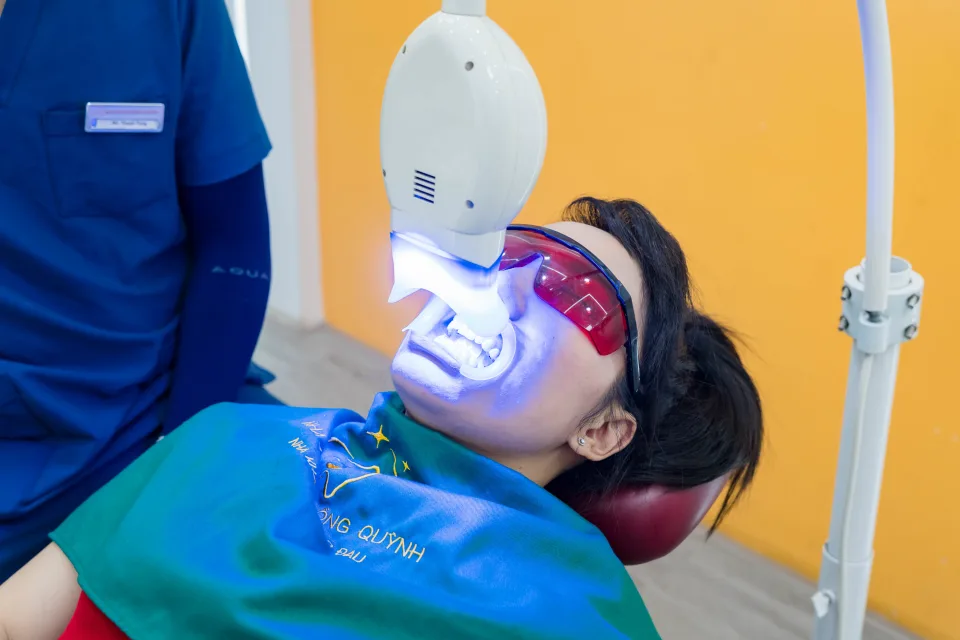
In-clinic laser whitening is performed during an appointment at the clinic. The gums and other soft tissues are protected before whitening gel is applied. A light device is then used according to the clinical protocol.
The main whitening procedure usually takes about 60-90 minutes. The complete visit also includes examination, discussion, shade assessment, preparation, soft-tissue protection, and aftercare guidance.
The timing may change if preliminary care is needed, sensitivity is significant, or the dentist needs to adjust the procedure according to your response.
In-clinic treatment may be convenient for someone who wants the main whitening procedure completed during one appointment. It does not guarantee a specific number of shades or eliminate the possibility of sensitivity.
Custom take-home whitening
Custom take-home whitening uses trays made to fit your teeth and gel supplied by the clinic.
The package costs 1,700,000 ₫, approximately $67, and includes custom trays and 2 tubes of gel.
The trays can usually be prepared in approximately one hour after the required clinical steps are completed. Collection timing depends on the examination and appointment arrangements, so confirm this with the clinic if your schedule in Hanoi is limited.
You will receive instructions covering:
- How to place and remove the trays.
- How much gel to use.
- How long to wear the trays each time.
- How to clean and store them.
- What to do if sensitivity or gum irritation develops.
- When to stop and contact the clinic.
There is no fixed number of whitening days for everyone. The schedule depends on your starting shade, response, treatment goal, and sensitivity.
Do not add more gel, increase the wearing time, or continue beyond the recommended schedule in an attempt to obtain a faster result.
Comparing in-clinic and take-home whitening
Neither method should be selected only because it appears faster or less expensive.
The recommendation also depends on:
- The cause and pattern of discoloration.
- Current tooth and gum health.
- Existing sensitivity.
- Crowns, veneers, implants, or fillings in visible areas.
- Your ability to use trays consistently.
- Your available time in Hanoi.
- How follow-up can be arranged after departure.
Can whitening fit into a short stay in Hanoi?
In-clinic whitening may be possible during a short stay when the examination confirms that treatment is suitable and an appointment is available.
Allow enough time for:
- Examination and discussion.
- The whitening procedure.
- Initial review of sensitivity and aftercare instructions.
- Follow-up if you develop a concern before leaving Hanoi.
For take-home whitening, allow time for the examination, tray preparation, fitting, and instructions. The trays can usually be prepared in approximately one hour, but this should be confirmed when booking.
You may continue an approved take-home schedule after leaving Hanoi if the dentist considers this appropriate and you understand how to use the trays. Ask about gel storage, transport, sensitivity management, and how to contact the clinic before departure.
When whitening may need to wait
Whitening may need to be postponed or replaced by another approach when:
- There is untreated tooth decay.
- A tooth is cracked, broken, or painful.
- The gums are inflamed, swollen, sore, or bleeding significantly.
- Exposed root surfaces are already sensitive.
- Sensitivity is substantial before treatment.
- One tooth has changed color because of trauma, pulp damage, or root canal treatment.
- The main concern is the color of a crown, veneer, implant, or filling.
- The treatment goal requires a major change in tooth shape or position.
- Another dental or medical factor needs to be considered first.
The decision is based on examination findings rather than a universal rule.
What happens during in-clinic whitening?
1. Discuss your goals and schedule
Explain what you would like to change, previous whitening experience, sensitivity history, available dates, and departure date.
2. Examine the teeth and gums
The dentist checks for decay, cracks, worn areas, exposed roots, gum concerns, and existing restorations.
3. Review suitability, limitations, and cost
You are given an explanation of the proposed method, realistic limitations, sensitivity risk, appointment timing, and treatment price.
4. Record the starting shade
The initial shade may be recorded to help evaluate the change. Lighting and tooth hydration can affect how color appears, so this is not a guarantee of a particular number of shades.
5. Protect the lips, gums, and soft tissues
Protective measures are placed before whitening gel is used. Tell the dentist immediately if you experience unusual heat, burning, or discomfort.
6. Apply the gel and use the light device
The whitening gel and light device are used according to the treatment protocol. Your comfort and soft tissues are monitored during the appointment.
7. Clean and reassess
The gel is removed, the teeth and gums are checked, and you receive instructions about sensitivity, food and drinks, and follow-up.
What happens with custom take-home whitening?
1. Examination
The dentist assesses your teeth, gums, sensitivity, discoloration, and visible restorations.
2. Preparation of custom trays
The required steps are completed to make trays that fit your teeth. The trays can usually be prepared in approximately one hour, depending on the examination and appointment arrangements.
3. Tray fitting
The fit is checked, and you are shown how to insert, remove, clean, and store the trays.
4. Gel instructions
You receive instructions for the amount of gel, wearing time, and expected schedule. Using excessive gel can increase leakage onto the gums without providing a better controlled result.
5. Monitoring sensitivity and progress
The schedule may be adjusted according to sensitivity and color change. Stop using the gel and contact the clinic if irritation or sensitivity becomes difficult to manage.
Sensitivity and gum irritation
Temporary tooth sensitivity can occur during or after whitening. You may notice a stronger response to cold drinks, cold air, sweet food, or other temperature changes.
Sensitivity may be influenced by:
- Previous sensitivity.
- Exposed root surfaces or cervical wear.
- Existing restorations.
- Gel concentration and contact time.
- Frequency of use.
- Tooth structure and pulp condition.
Whitening gel can also irritate the gums if it contacts soft tissue. With take-home trays, use only the instructed amount and remove excess gel as directed.
Contact Hong Quynh Dental Clinic if:
- Sensitivity becomes stronger instead of improving.
- Pain continues after stopping the gel.
- You develop spontaneous, nighttime, or prolonged pain.
- The gums remain sore, ulcerated, or unusually discolored.
- One tooth reacts much more strongly than the others.
- You develop swelling or another unexpected symptom.
These symptoms may require an examination rather than being treated as a routine whitening response.
Crowns, veneers, implants, and fillings do not whiten
Whitening changes the color of natural teeth. It does not lighten porcelain, ceramic, Composite, or implant restorations in the same way.
Visible restorations may therefore appear different from newly whitened natural teeth. Existing restorations should be identified before treatment so that this possibility can be discussed.
Not every crown, veneer, or filling needs replacement after whitening. Replacement or repair should be considered only if the color, edges, seal, condition, or appearance is no longer acceptable.
Whitening before bonding, veneers, crowns, or new fillings
If you are considering Composite bonding, porcelain veneers, dental crowns, or replacement fillings, discuss the complete plan before starting.
Whitening may be planned before selecting the shade of a new restoration. The dentist will advise when the tooth color is ready to be reassessed and when material shade selection should take place.
If a restoration is completed first, it will not lighten with the natural teeth during later whitening. This can create a visible color difference.
Results, staining, and maintenance
There is no guaranteed number of shades and no fixed result duration for every patient.
Results and maintenance depend on:
- The original shade and cause of discoloration.
- Coffee, tea, tobacco, and strongly colored food or drinks.
- Oral hygiene.
- The selected whitening method.
- Your response to treatment.
- How closely take-home instructions are followed.
- Future cleaning and dental care.
Whitening is not permanent. Teeth may become darker or stained again over time.
Do not repeat whitening only because a fixed period has passed. The teeth, gums, sensitivity, and previous gel use should be reviewed before additional treatment is recommended.
Looking after your teeth after whitening
After treatment:
- Brush regularly and clean between the teeth.
- Follow any sensitivity guidance provided by the dentist.
- Limit tobacco and strongly colored food or drinks, especially while using take-home gel.
- Rinse with water after colored drinks when practical.
- Clean and store the trays as instructed.
- Do not share trays or whitening gel.
- Do not extend the schedule without advice.
- Avoid acidic or abrasive do-it-yourself whitening methods.
- Arrange an assessment if pain or sensitivity persists.
Whitening does not replace treatment for decay, gum care, professional cleaning, or routine oral hygiene.
Follow-up after leaving Hanoi
If you have a question after leaving Hanoi, contact Hong Quynh Dental Clinic with:
- The treatment date and whitening method.
- The symptoms or concern.
- When the problem started.
- Whether you have stopped using take-home gel.
- Clear photographs if there is a visible concern.
Photographs may help explain a visible issue but cannot replace an examination.
If you develop increasing pain, facial swelling, fever, difficulty swallowing or breathing, or another urgent symptom, seek prompt dental or medical care where you are currently located.
Contact Hong Quynh Dental Clinic
Hong Quynh Dental Clinic is located at 14 Lane 36 Mieu Dam Street, Tu Liem, Hanoi.
- WhatsApp: Message the clinic.
- Zalo: Contact the clinic.
- Phone: +84 965 794 622.
- Appointment: Request an appointment.
- Directions and visit information: English contact page.
For the quickest initial response, send your whitening goals, sensitivity history, existing restorations, available dates, and departure date through WhatsApp. The clinic can then confirm appointment availability and the next step.